
Most risk registers are archaeology.
Written once during certification, printed, filed, and never opened again until the next surveillance visit.
Never reviewed
Controls set two years ago with no evidence anybody checked they still work.
Field reports go nowhere
A hazard gets mentioned at toolbox and never reaches the register.
No link to reality
The register says one thing; the incidents and inspections say another.
How it works
From spotted to controlled to verified.
01
Capture the hazard
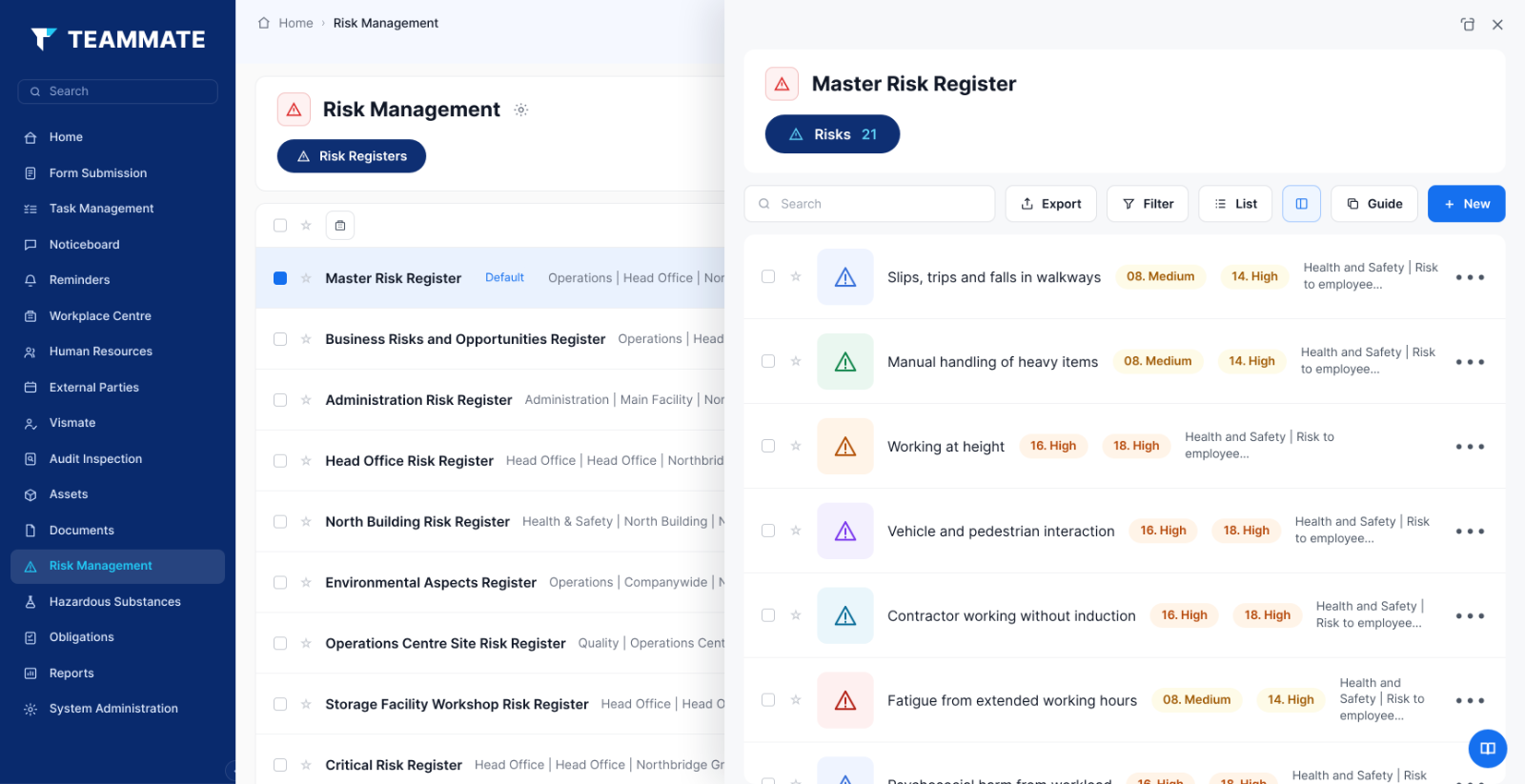
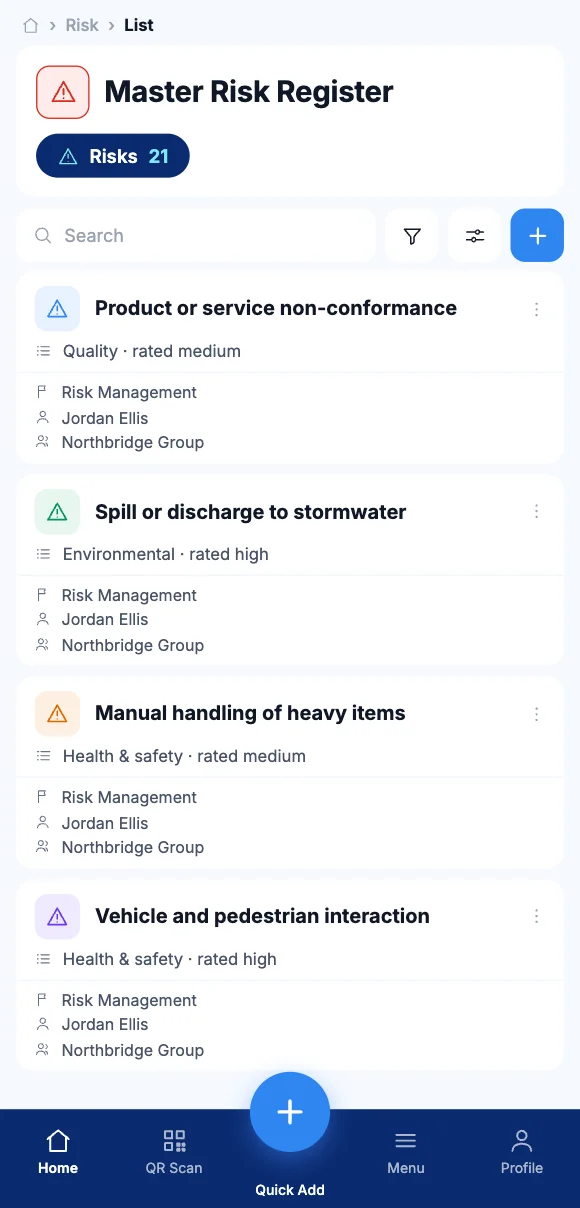
Anyone can report from a phone with a photo. It lands in the register, not a notebook.
02
Assess it
Likelihood and consequence on your matrix, with an inherent and residual score.
03
Record the controls
Link the SOP, the training, the PPE and the plant that manage it.
04
Prove they still work
Review dates raise tasks. Inspections verify the control is in place.
Controls that point at real evidence.
A control isn’t a sentence in a register — it’s a document, a competency, a service record or an inspection. Teammate links the control to the thing that proves it.
- Linked to documents — The SOP that manages the risk, at its current version.
- Linked to competency — Who’s trained, and whether that training is current.
- Linked to incidents — What actually happened, against what you predicted.
Works with
Risk is the centre of the system.
Nearly every other module either creates risk information or proves a control is working.