
You know the obligations. Proving them is the work.
Consent conditions, licence renewals, reporting deadlines and clause requirements spread across people who each hold part of the picture.
Deadlines missed
An annual return or a consent condition slips because it lived in one person’s calendar.
Evidence scattered
The proof exists somewhere — in an inbox, a folder, or a completed form nobody linked.
No line of sight
Management can’t answer “are we compliant” without a week of asking around.
How it works
Register it, own it, evidence it.
01
Capture the obligation
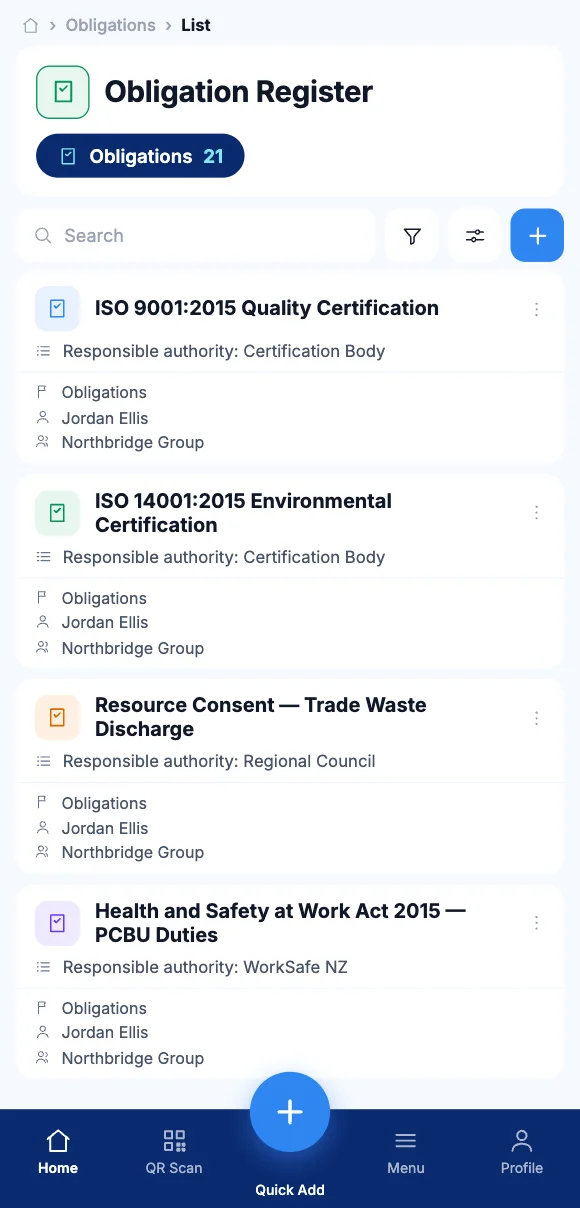
The source — act, regulation, consent, standard or contract — and what it actually requires.
02
Assign and schedule
An owner, a frequency and a due date. Annual, quarterly, or one-off.
03
Link the evidence
The form, audit, document or record that demonstrates compliance.
04
Report the status
A live view of met, due and overdue, by site and by source.
Compliance you can show, not assert.
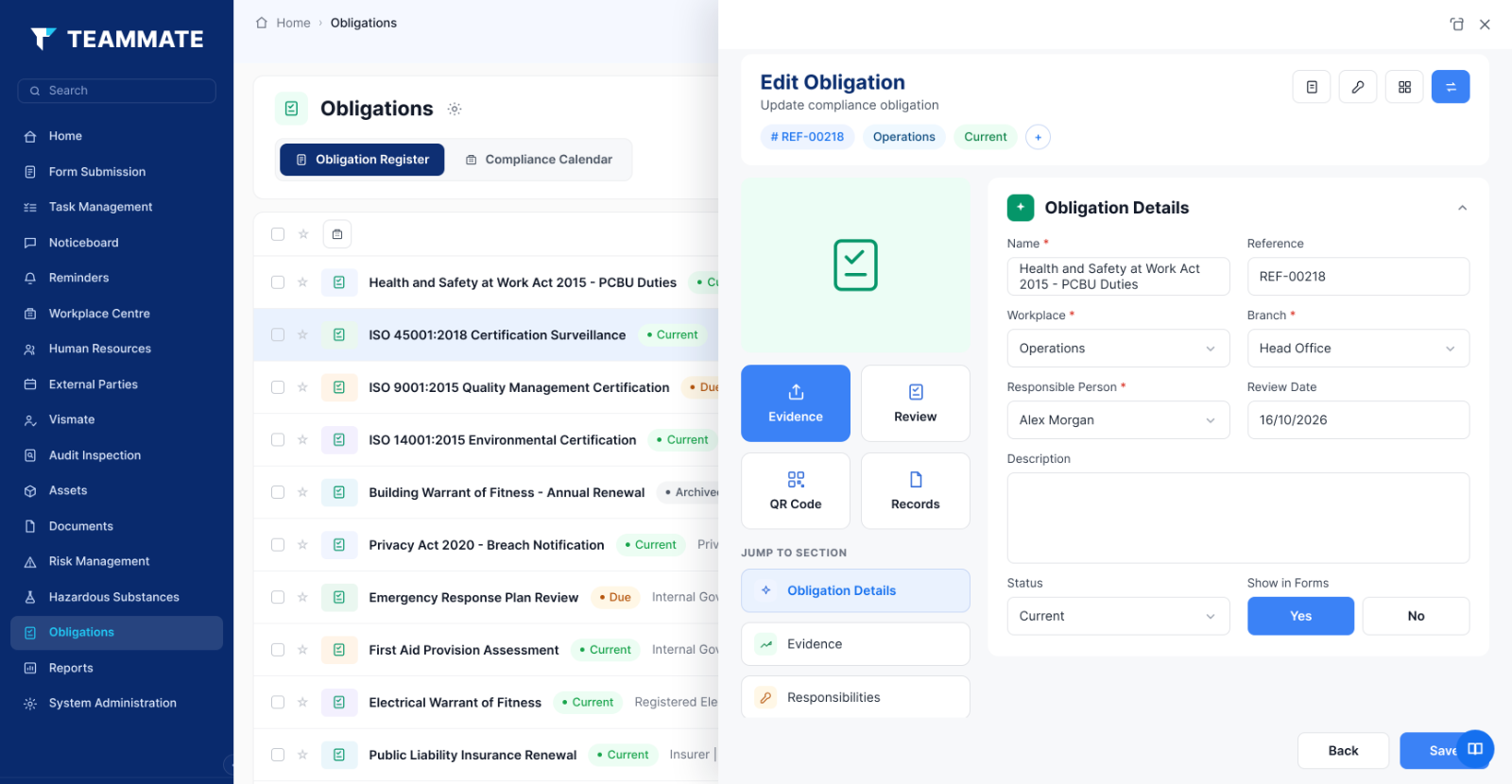
When a regulator or a certification auditor asks how you meet a requirement, you open the obligation and the evidence is already attached to it.
- Clause-level mapping — Tie obligations to ISO clauses for integrated systems.
- Evidence from other modules — A completed audit or form satisfies the duty automatically.
- Management reporting — Compliance status by site, source and owner for management review.
Works with
Obligations pull evidence from everywhere.
Almost nothing is evidenced by the obligations register itself — it points at the work done in the other modules.