
First: is it actually notifiable?
Under the Health and Safety at Work Act 2015, a notifiable event is a death, a notifiable injury or illness, or a notifiable incident arising from work. Where one occurs, the PCBU must notify WorkSafe as soon as possible after becoming aware of it. The test is not how serious it looked at the time or whether anyone was hurt.
- A death of any person arising from work.
- A notifiable injury or illness — the categories are defined in the Act and include amputation, serious head or eye injuries, serious burns, degloving or scalping, loss of bodily function, serious lacerations and admission to hospital for treatment.
- A notifiable incident — an unplanned or uncontrolled incident that exposed anyone to a serious risk to health or safety, whether or not an injury occurred.
The category most often missed
Notifiable incidents. An uncontrolled escape of a substance, an electric shock, a collapse or failure of plant, an implosion or explosion, or a fall that could have killed someone can all be notifiable with nobody injured at all. Organisations under-notify here, and under-notification is itself a finding.
The first hour
- 1.Make the area safe and get medical help. Nothing below outranks this.
- 2.Preserve the scene. The Act requires the site not to be disturbed until an inspector allows it, apart from what is needed to help someone, remove a body, make the site safe, or protect essential services.
- 3.Notify WorkSafe as soon as possible — by phone for the serious end, through the notification form otherwise.
- 4.Tell your other duty holders: overlapping PCBUs, the site owner, the head contractor, and the affected worker’s employer if it is not you.
- 5.Open one file, with timestamps, and put everything in it from the beginning.
- 6.Nominate one person to speak to the regulator, and one to speak to staff.
Before anything moves
Photograph the scene from several distances before anything is touched — including the things that seem irrelevant, like the state of the housekeeping and what was written on the whiteboard. You cannot go back and take that photograph later.
What actually gets requested
The request almost never stops at the incident report. It reaches backwards into whether the risk was known and managed before the event.
- The incident report and the investigation, including who conducted it and when.
- The risk assessment for the task, and its review history with dates.
- The safe operating procedure or safe work method, and evidence the people involved were trained in that version.
- Competency, licence and authorisation records for everyone involved, current at the date of the event.
- Maintenance, pre-start and inspection records for any plant or equipment involved.
- The hazard register entry, and when it was last reviewed and by whom.
- Induction and training records, including refreshers, for the workers and any contractors present.
- Contractor prequalification, induction and site-specific safety plans where a contractor was involved.
- Consultation records — toolbox talks, committee minutes, and any worker concern raised about that task.
- Previous similar incidents or near misses, and what was done about them.
The gap is almost never the incident form. It is the six months before it.
Records you must keep, and for how long
The Act requires records of each notifiable event to be kept for at least five years from the date of notification. Other retention periods sit in the regulations and some are far longer, particularly for health monitoring and exposure records.
- Notifiable event records — five years minimum, and in practice keep them permanently.
- Health monitoring and exposure records — governed by regulation, and materially longer.
- Training and competency records — for as long as the person works for you, plus a margin.
- Plant maintenance and inspection records — the working life of the asset.
- Anything connected to an event you notified — treat as permanent, whatever the minimum says.
Investigate for cause, not for blame
- 1.Secure the facts while they are fresh — statements, photographs, equipment state, conditions.
- 2.Build a timeline before forming a theory. Most flawed investigations pick a cause first.
- 3.Ask what made this possible, not who did it. The second question stops the first from being answered honestly.
- 4.Test the hierarchy of controls. Could the hazard have been eliminated? If not, why not, and is that reasoning written down?
- 5.Identify the systemic causes — scheduling pressure, a control that was impractical, training that covered the wrong version, a hazard nobody owned.
- 6.Write corrective actions that change the system, each with an owner, a date, and a separate effectiveness check.
The weakest common finding
“Retraining the worker” as the sole corrective action. It appears in a large share of investigation files and it satisfies neither a regulator nor a certification auditor, because it accepts that the system will produce the same outcome with the next person.
Where organisations get caught out
- No consistent timestamps, so the sequence cannot be reconstructed.
- Photographs on personal phones that never make it into the file.
- A risk assessment for the task dated after the event.
- Training records that prove attendance but not competence.
- Corrective actions with no named owner, no due date, and no verification.
- A hazard register whose last review was two years ago.
- Contractor records held by the contractor rather than by you.
A five-minute readiness test
Ask these of your own system today, and time yourself honestly.
- 1.Can you produce the last review date and the named owner of the hazard register entry for your highest-risk task?
- 2.Can you show that every person who performed that task last month was trained in the current version of the procedure?
- 3.Can you produce the last three pre-start records for the plant used in it?
- 4.Can you show a worker concern raised about it, and what happened next?
- 5.Can you show the last corrective action from a similar incident, and the evidence it worked?
If any of those takes longer than five minutes, that is the work — not another form.
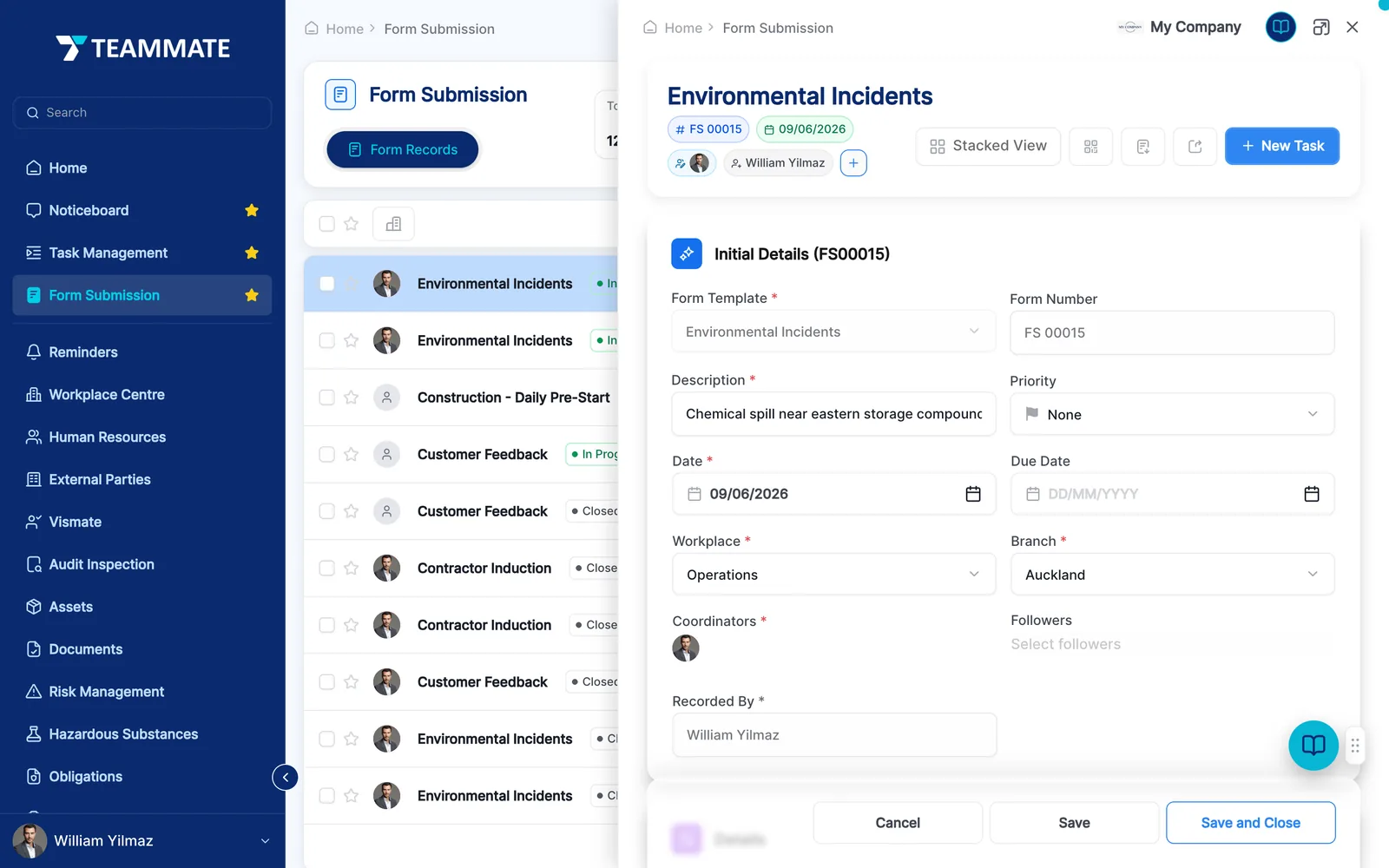
Questions we get asked
What makes an event notifiable?
Notifiable events are defined by category — death, notifiable injury or illness, and notifiable incident — rather than by how serious it felt at the time. The categories are specific, and the common mistake is judging by outcome instead of checking the definition. Have the definitions to hand before you need them, not during.
How quickly do we have to notify?
As soon as possible after becoming aware of the event, with written notice following within the required period. The practical implication is that the decision cannot wait for the investigation — you notify on the category, then investigate.
Can we clean up or move things after an incident?
Not until you are permitted to. The scene generally must be preserved so far as is reasonably practicable, with exceptions for making the site safe, helping an injured person and preventing further harm. Photograph before anything moves, and record who authorised any change.
How long do we have to keep the records?
Retention periods vary by record type, and health monitoring and exposure records are kept far longer than incident reports. Set the retention rule per record type in advance rather than deciding at the point of disposal.
Do we have to hand our investigation report to the regulator?
An inspector can require the production of documents, so assume anything you create may be read. That is an argument for writing investigation findings carefully and factually — focused on cause and control, not on blame or speculation — rather than an argument for not writing them.
General guidance on New Zealand’s Health and Safety at Work Act 2015 and its regulations. Definitions, duties and retention periods should be verified against the current legislation and WorkSafe guidance for your circumstances. This is not legal advice.