
Why the register goes stale
Almost every contractor register starts well. Someone builds it, chases the certificates, and for a quarter it is accurate. Then the pattern sets in.
- Certificates collected once at onboarding and never again.
- Expiry dates living in one person’s calendar, or nowhere.
- Renewals chased by email, so currency depends on who is on leave.
- No link between the contractor record and the site or task they are approved for.
- No record of what was checked, by whom, and when — so it cannot be evidenced later.
Overlapping duties, in plain terms
Under the Health and Safety at Work Act 2015, where more than one PCBU has a duty in relation to the same matter, each must consult, cooperate with and coordinate activities with the others so far as is reasonably practicable. Engaging a contractor does not move your duty to them.
You cannot contract out of a duty. You can only evidence that you discharged it.
What to collect — and what not to
Always
- The actual legal entity doing the work, not the trading name on the quote.
- Insurances with expiry dates — public liability, motor vehicle, and statutory liability where relevant to the work.
- The scope of work they are approved for, in your words.
- Their health and safety policy, and the name of the person accountable for it.
- Risk assessments or safe work method statements for their high-risk activities.
- Competency, licence and authorisation evidence for the individuals who will actually attend.
- Incident history and any regulator enforcement action.
- Their sub-subcontractor arrangements, because their subcontractors become your problem too.
Only if you will genuinely use it
- Full manuals nobody will open. Collecting them creates an obligation to have read them.
- Generic template policies with another company’s name still in the footer.
- Third-party scheme certificates that do not cover the scope of work you are engaging them for.
Proportionality
A window cleaner on a single-storey building and a live electrical contractor should not face the same pack. Tier your requirements by the risk of the work, write the tiering down, and apply it consistently — an auditor will accept a light pack for low-risk work if the reasoning is documented, and will not accept an inconsistent one.
How often to re-check
- Insurances — automatically at expiry, not annually by habit.
- Licences and tickets — at expiry, per person, not per company.
- Safe work methods — annually, and whenever the scope, the site or the plant changes.
- Incident history — annually, and after any event involving them.
- The whole pack — before each new engagement, or at least annually for ongoing suppliers.
Site-specific, not just company-level
Prequalification qualifies a company. It does not qualify the person standing on your site on Tuesday morning. The two are routinely conflated, and it is where most contractor findings originate.
- 1.The company is approved for a defined scope of work.
- 2.The individuals attending are verified against the tickets that scope requires.
- 3.A site induction is delivered on arrival and recorded against the person.
- 4.The task-level method statement or permit is reviewed and accepted before work starts.
- 5.Sign-in records who is actually on site, and when they left.
- 6.The work is monitored while it happens, and the monitoring is recorded.
Monitoring — the part that gets skipped
Collecting documents is the easy half. Verifying that the work matches them is what an auditor treats as evidence of an actual system.
- Planned observations of their work against their own method statement.
- A short performance record per engagement, not a folder.
- Incidents and near misses recorded against the contractor as well as the site.
- A review at the end of each engagement that informs whether they are re-engaged.
- Written consequences — because a process with no consequence is a filing system.
What an auditor will test
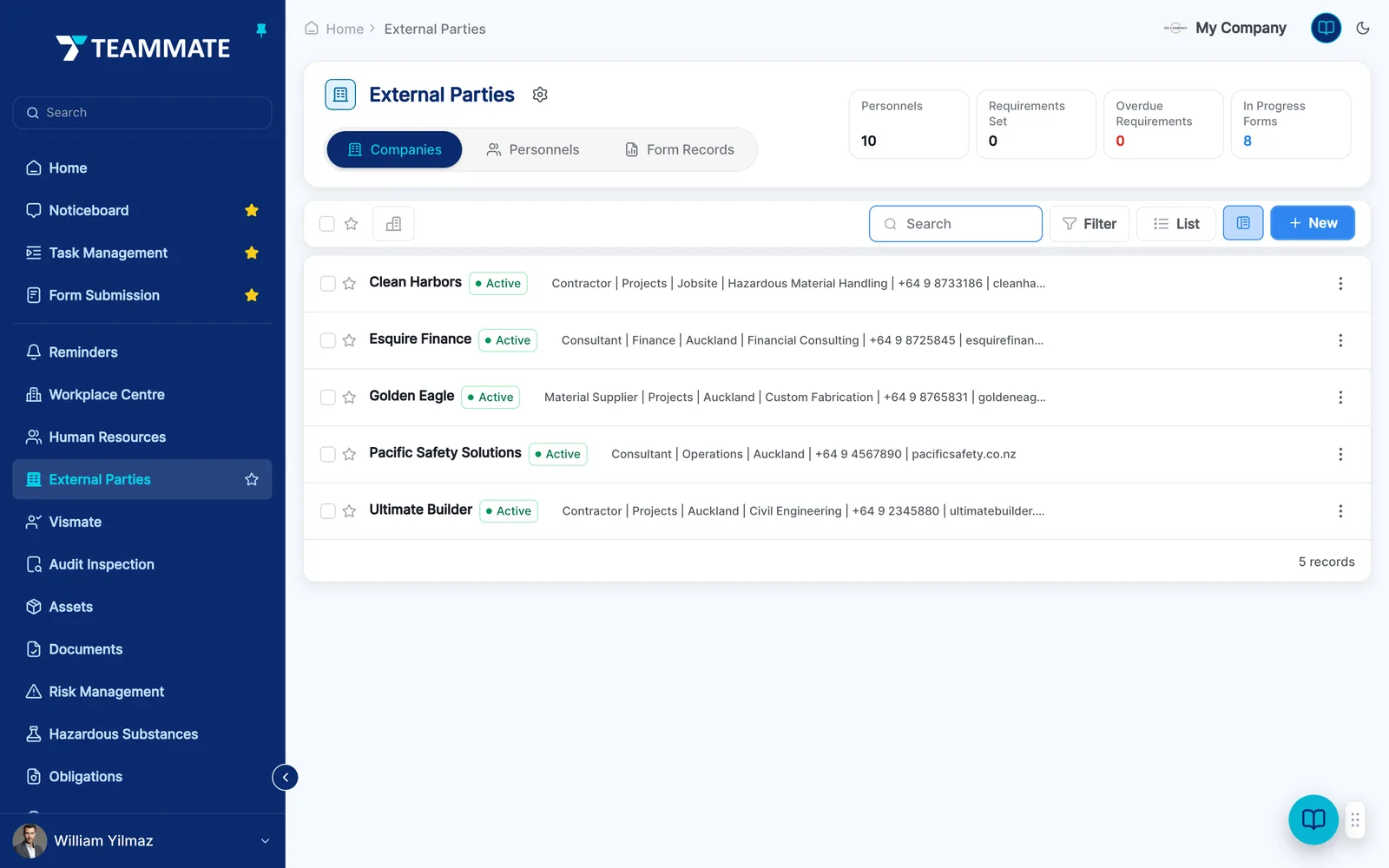
- 1.Show me your approved contractor list, and when each record was last reviewed.
- 2.Pick one at random — show me their insurance is current today.
- 3.Show me the induction record for the individual who worked here last week.
- 4.Show me a monitoring record from work carried out this quarter.
- 5.Show me what happened after their last incident, and the evidence it was closed.
If all five can be answered from one place in a few minutes, the register is doing its job. If they require three inboxes and a phone call, it is documentation rather than a system.
Questions we get asked
What is the difference between prequalification and induction?
Prequalification asks whether an organisation is capable and covered before it is engaged — insurances, competencies, safety systems, history. Induction happens once they arrive and covers this site, these hazards, these rules. Doing one well does not substitute for the other, and auditors check both.
How often should contractor evidence be re-checked?
Tie the check to the expiry date on the document rather than to a calendar cycle. Insurance certificates, licences and tickets all carry their own dates, and a register that re-checks everyone annually will still let an expired certificate through for eleven months.
Do we need to prequalify every contractor?
Proportionality is accepted. Scale the depth of prequalification to the risk of the work: high-risk trades get the full process, while a low-risk supplier delivering to a loading dock does not need the same file. What is not accepted is having no basis for the distinction — write the tiering down.
Can we rely on a third-party prequalification scheme?
You can use one as evidence, but the duty does not transfer. A scheme tells you a contractor met a general standard on a date; it does not tell you they are competent for your specific work on your specific site. Most organisations use the scheme as the baseline and add their own site-specific layer.
What will an auditor actually test?
Almost always the same thing: pick a contractor who worked on site recently, and follow the trail. Were they prequalified before they started, was their evidence current on the day, were they inducted, and is there a record of anyone monitoring the work. Gaps show up in that sequence, not in the policy document.
General guidance on New Zealand’s Health and Safety at Work Act 2015. Duties and requirements should be verified against the current legislation and your own circumstances. This is not legal advice.