
Aspects and impacts, done once and properly
The aspects and impacts register is the foundation of ISO 14001, and it is where weak systems reveal themselves fastest. An aspect is an element of your activities that can interact with the environment — a discharge, an emission, a material use. The impact is what that interaction does. Get this wrong and everything built on it is decoration.
The common failure is a register assembled in a workshop by people who do not do the work, ranked with a scoring matrix that produces the answer everyone expected. It lists twenty aspects, rates three as significant, and never changes again.
- Walk the site. Aspects are found where material moves, not in a meeting room.
- Cover the whole lifecycle perspective the standard asks for — including what happens upstream of your gate and after your product leaves it.
- Include abnormal and emergency conditions, not just normal operation. A bund that works at steady state and fails during a transfer is a real aspect.
- Record the reasoning behind each significance rating. An auditor is testing the logic, not the score.
- Set a trigger for review — a new process, a new chemical, a new site — rather than an annual date that arrives after the change.
The test that finds weak registers
Pick your largest environmental risk as an operations person would describe it. Then find it in the register. If it is absent, or rated as not significant, the register was written to be finished rather than to be true.
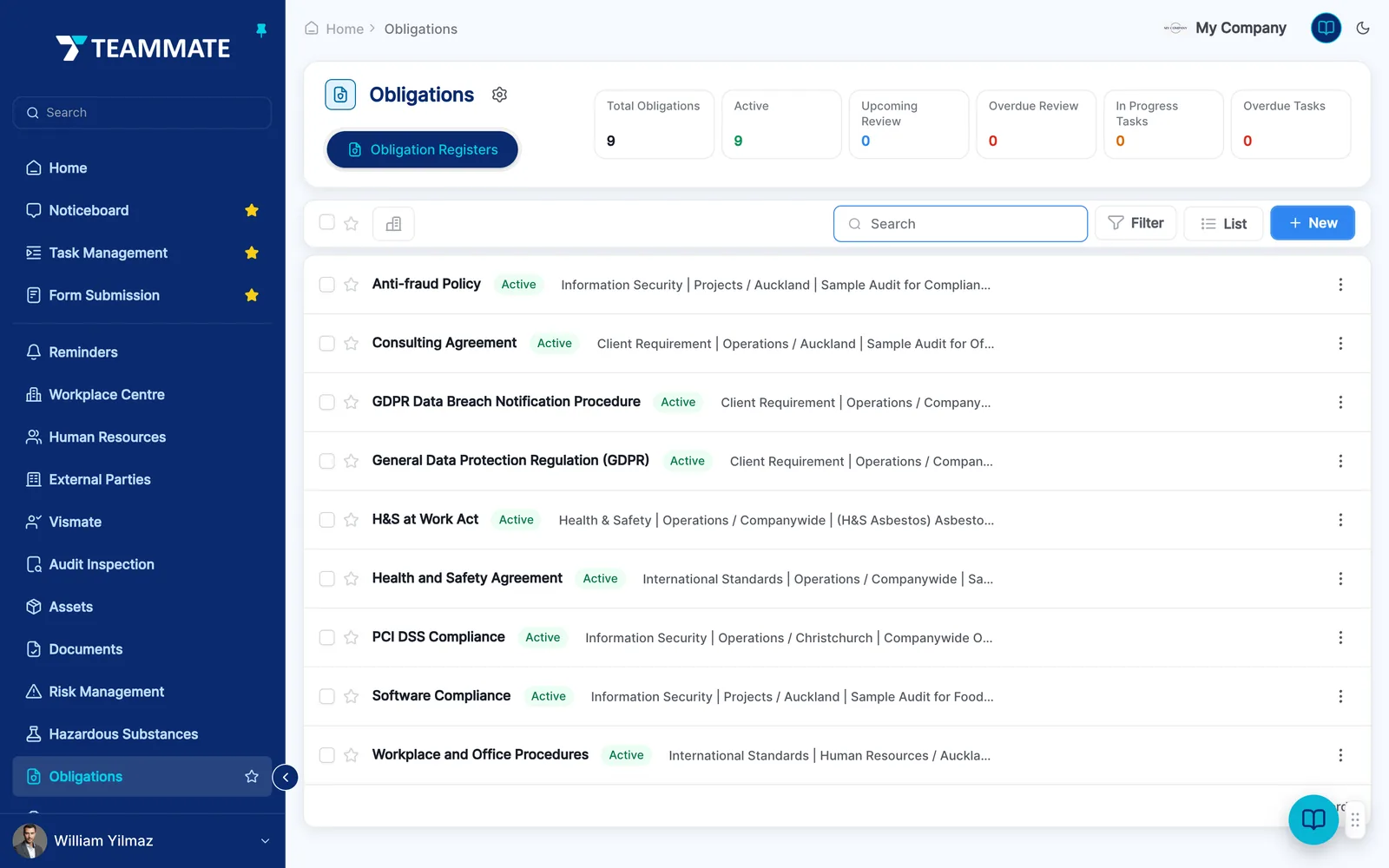
Obligations are a register, not a folder
Compliance obligations under ISO 14001 include legal requirements and the other requirements you have signed up to — consent conditions, customer commitments, industry codes, community agreements. The standard asks you to determine them, know how they apply, and evaluate compliance against them.
A folder of PDFs satisfies none of that. What works is a register in which every obligation is broken down to the specific thing you must do, with an owner, a frequency and a place the evidence lands. Consent conditions in particular are usually written as a list of discrete duties, and that list maps almost directly onto a monitoring schedule.
- 1.List each obligation as a duty, not a document: "sample discharge monthly at point A", not "resource consent 12345".
- 2.Give every duty an owner and a frequency, and let the system generate the task rather than a person remembering.
- 3.Store the evidence against the duty, so evaluation of compliance is a query rather than a search.
- 4.Record the evaluation itself — the standard requires you to evaluate, and to keep the result, not merely to comply.
- 5.Review the register when the consent is varied, the site changes, or the regulator publishes something new.
Objectives that survive a budget round
Environmental objectives fail for an unglamorous reason: they are set by the environmental function and funded by nobody. A target to reduce waste to landfill by fifteen percent needs a bin contract, a change to how a production line handles offcuts, and somebody’s capital budget. If those conversations did not happen, the objective is a statement of hope.
Objectives that hold have four properties. They connect to a significant aspect, so they matter. They have a named owner with the authority to act. They have a resource decision already made. And they are measured with data you already collect, or will collect without heroics.
It is better to set two objectives that will genuinely be achieved than six that will be quietly restated next year. Auditors notice restated objectives, and management review is the wrong place to discover that nothing moved.
Operational control where it matters
Operational control is where the register turns into behaviour. For each significant aspect, something must constrain how the work is done: a procedure, a physical control, a competency requirement, a specification passed to a contractor.
The most-missed area is the one the standard is explicit about — controls extended to contractors and suppliers. Your bunding, your spill kits and your induction are irrelevant if the tanker driver delivering to your site works to their own process and nobody has ever specified yours to them.
- Tie each control back to the aspect it exists for, so the reason survives staff turnover.
- Prefer engineering controls to procedural ones. A valve that cannot be opened in the wrong sequence outperforms a page that says do not.
- Specify environmental requirements in contracts and purchase orders, not just in inductions.
- Check controls in the field during internal audit. A control that exists on paper and not in practice is worse than none, because it stops you looking.
Emergency response is tested, not written
ISO 14001 requires you to prepare for and respond to potential emergency situations, and where practicable to periodically test the planned response. That last clause is the one most systems skip, and it is where auditors find the gap.
A test does not need to be a full-scale exercise. Walking a spill scenario with the crew who would respond, at the location it would happen, finds most of what a real event would find: the spill kit that is locked, the drain that nobody knew connected to the stream, the after-hours contact number that belongs to someone who left.
Record the test, record what it exposed, and treat the exposures as corrective actions. A tested plan with three findings closed out is stronger evidence of a working system than an untested plan with none.
Questions we get asked
What is the difference between an aspect and an impact?
An aspect is the element of your activity that interacts with the environment — a discharge to water, an air emission, consumption of a raw material. The impact is the change that results, such as reduced water quality or resource depletion. The distinction matters because controls act on aspects, while significance is judged by impacts.
How often should the aspects register be reviewed?
Annually is the common default, but change should be the real trigger. A new process, a new chemical, a new site, a modified consent or an incident all warrant a review at the time, not at the next scheduled date. Auditors look for evidence that the register tracked a known change rather than lagging behind it.
Do we need to include suppliers and contractors?
Yes. The standard asks for a lifecycle perspective and for controls to be extended to relevant external parties. In practice that means specifying your environmental requirements in contracts and purchase conditions, and verifying them for the activities that touch your significant aspects.
Can ISO 14001 be integrated with ISO 9001 and ISO 45001?
Yes, and it is usually the better route. All three share the same high-level structure, so context, leadership, planning, support, operation, performance evaluation and improvement can be run once across the three systems. Integrated internal audits and a single management review save substantial time.
What does an auditor look at first in an environmental system?
Usually the aspects register, then the compliance obligations register, then whether the two connect to anything. If significant aspects have no corresponding operational controls, and obligations have no evidence of evaluation, the rest of the system is unlikely to survive sampling.
General guidance written against ISO 14001:2015. The current edition is ISO 14001:2026, published in April 2026; the approach below still applies, but requirements, clause numbering, consent conditions and your regulator’s expectations should be verified against your current copy of the standard and your own consents. Organisations certified to the 2015 edition have until 30 April 2029 to transition — see our ISO 14001:2026 transition guide. This is not legal advice.